
Photos, on demand.
Anywhere.
Someone needs eyes on an address they cannot get to. Someone else is already standing two miles away with a phone. SnapDash is the mechanism that makes those two people safe to rely on each other.
The problem
One person, one Friday, one apartment she has never seen.
The $3,200 decision
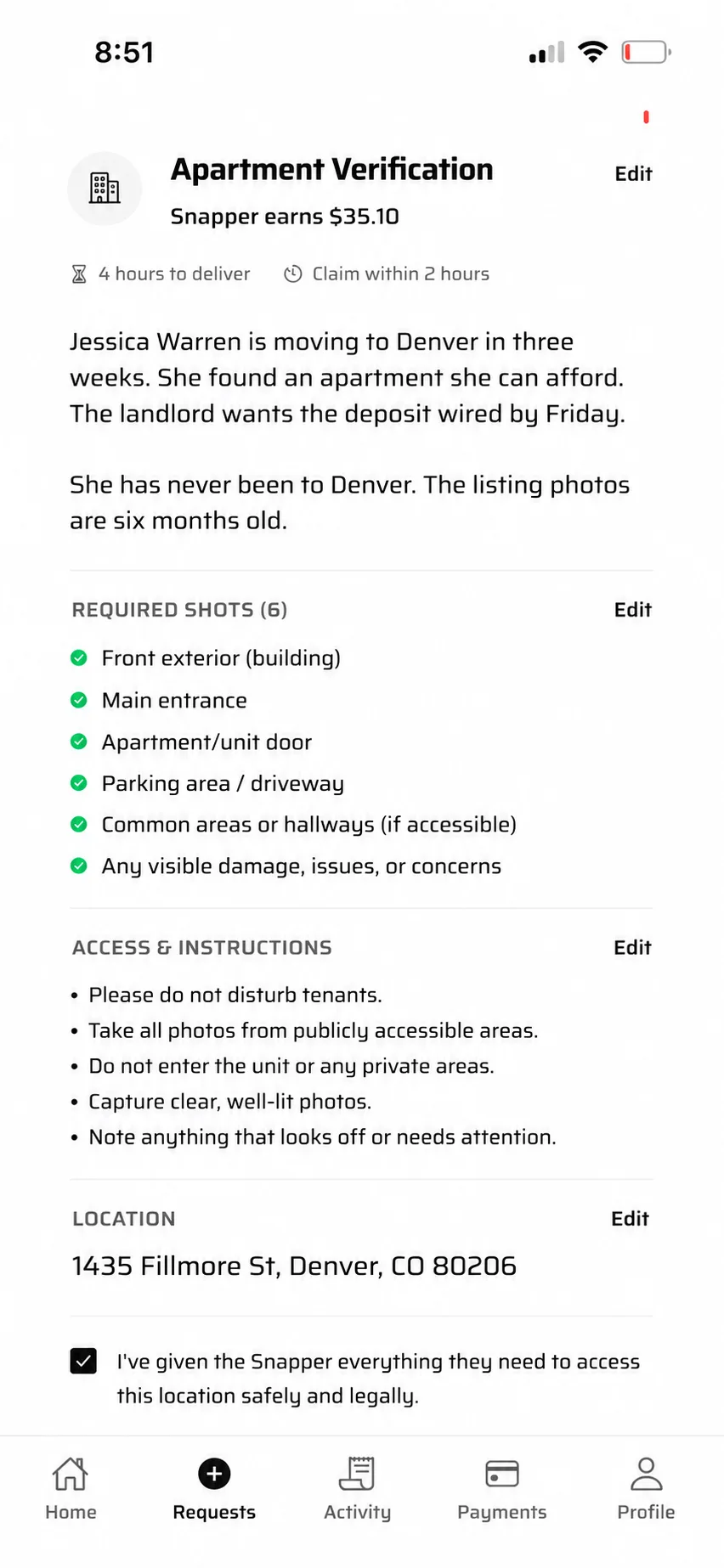
Jessica Warren is moving to Denver in three weeks. She found an apartment she can afford. The landlord wants the deposit wired by Friday.
She has never been to Denver. The listing photos are six months old.
Illustrative scenario. Jessica and Emily are a walkthrough of how SnapDash works, not a real job — SnapDash is pre-launch, with no completed jobs yet.
Three bad options
FBI Internet Crime Complaint Center, 2025 Annual Report — 12,368 complaints, $275.1M. IC3's real-estate fraud category covers rental, timeshare and investment property.
The photo was never the hard part.
Trust was.
The challenge wasn't taking the photo. It was trusting a stranger.
The product
Three steps, two people, and four mechanisms that make a stranger safe to rely on.
Post. Match. Approve.
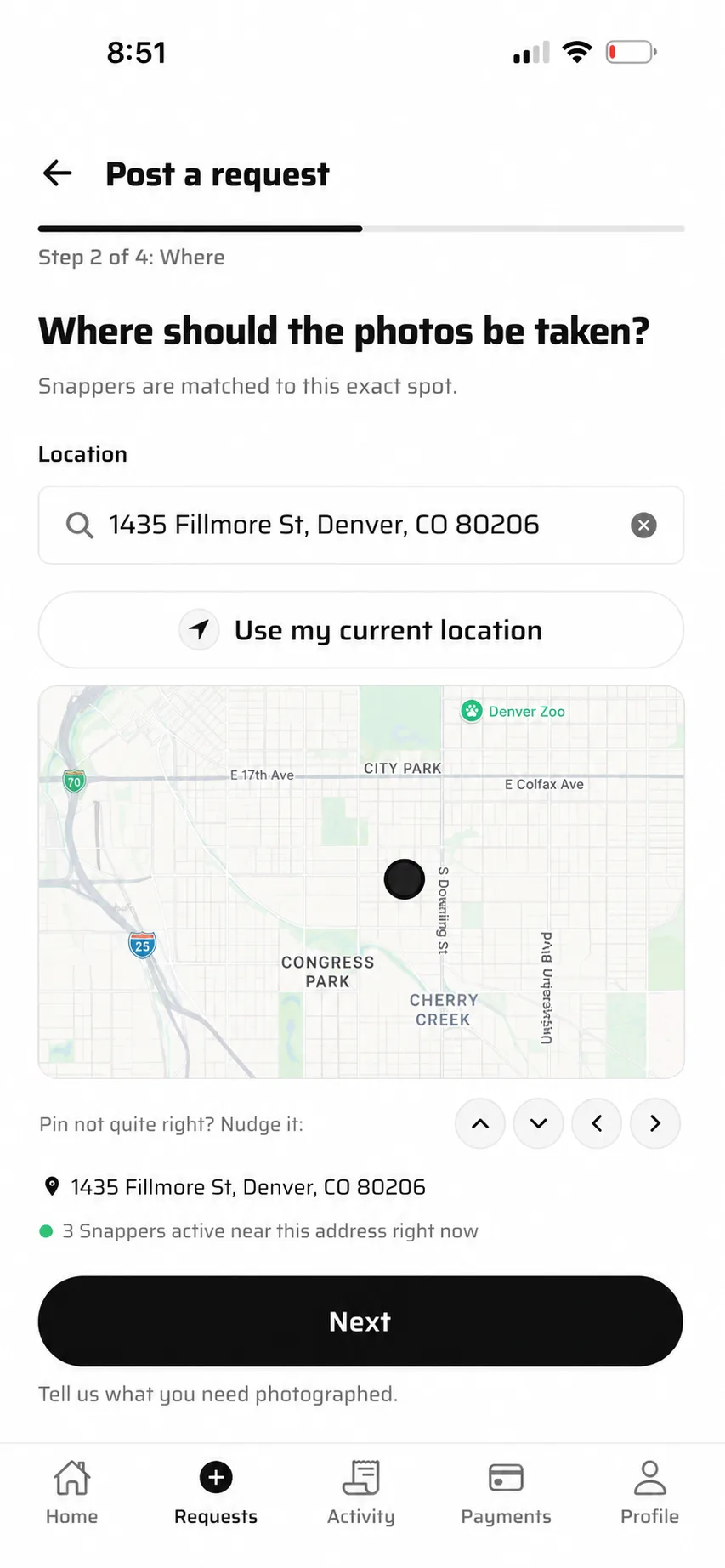
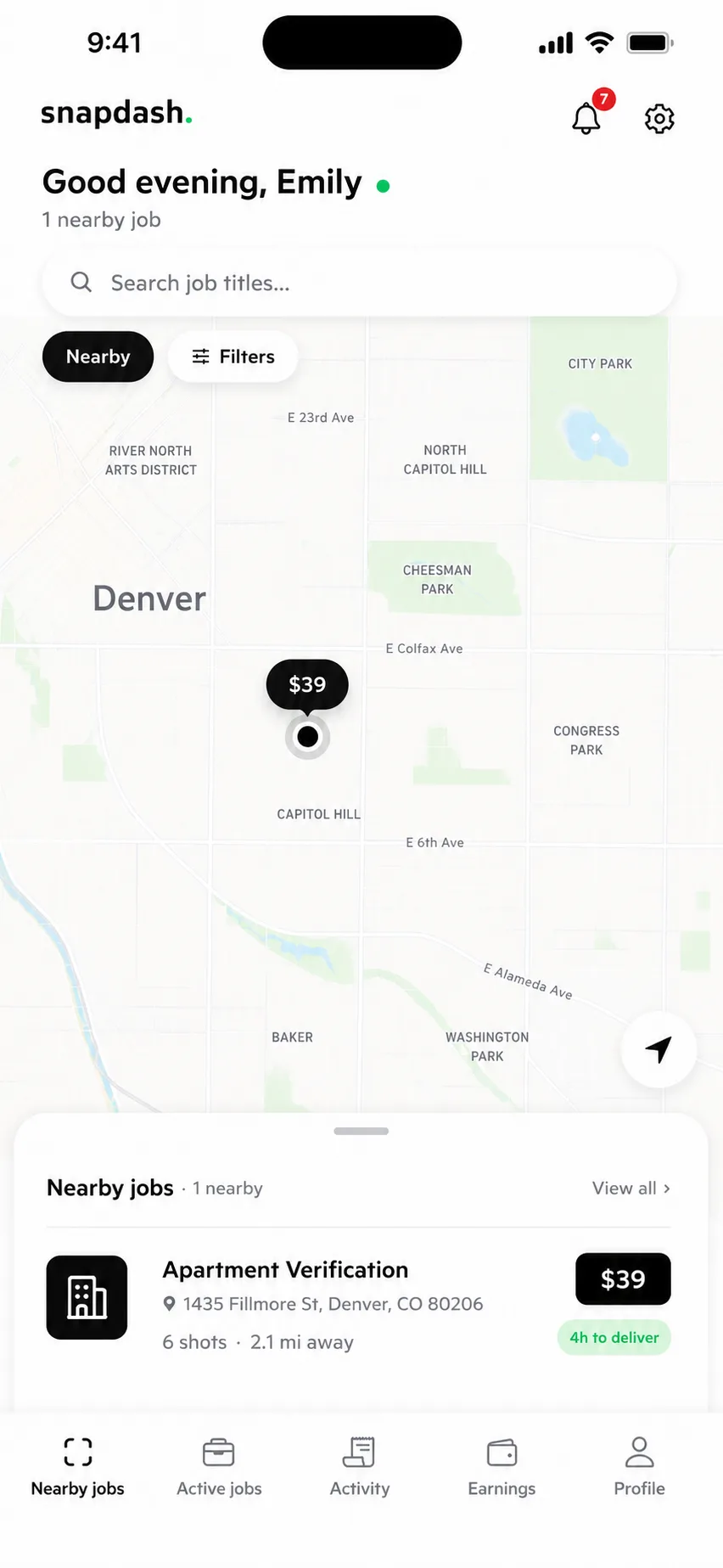
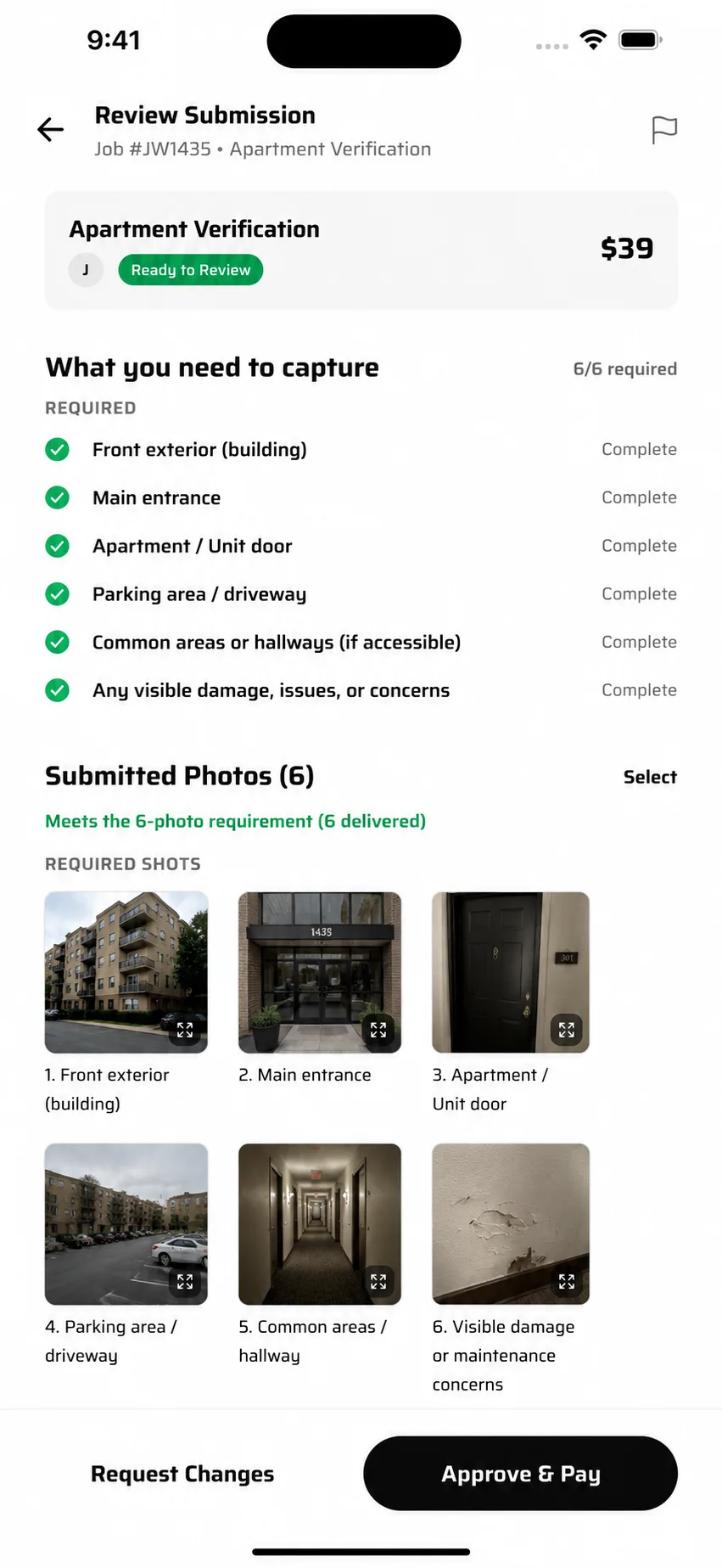
The loop
Needs eyes on an address 1,000 miles away.
Has $39, a Friday deadline, and no way to get there.
Already out driving, 2.1 miles away.
Wants $35.10 for a detour on a shift she was already driving.
- From Jessica: The job, the shot list, the money — held
- From Emily: Twenty minutes and a phone
- From Emily: Four photos, taken on site
- From Jessica: Approval. Now the money moves.
Thirteen minutes
The alternative would have been a $400 flight and two days off work.
Posting a job
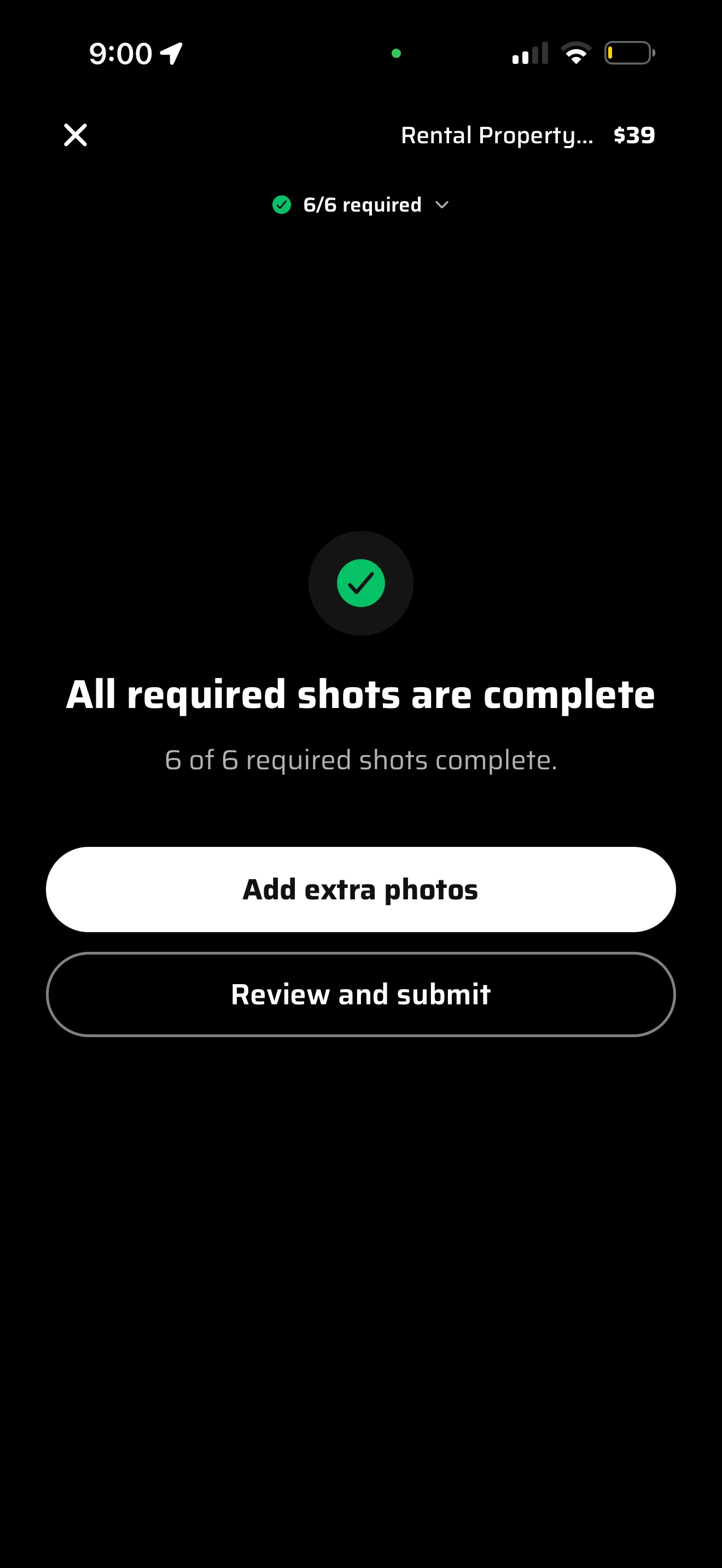
Six required shots. $39, four hours to deliver.
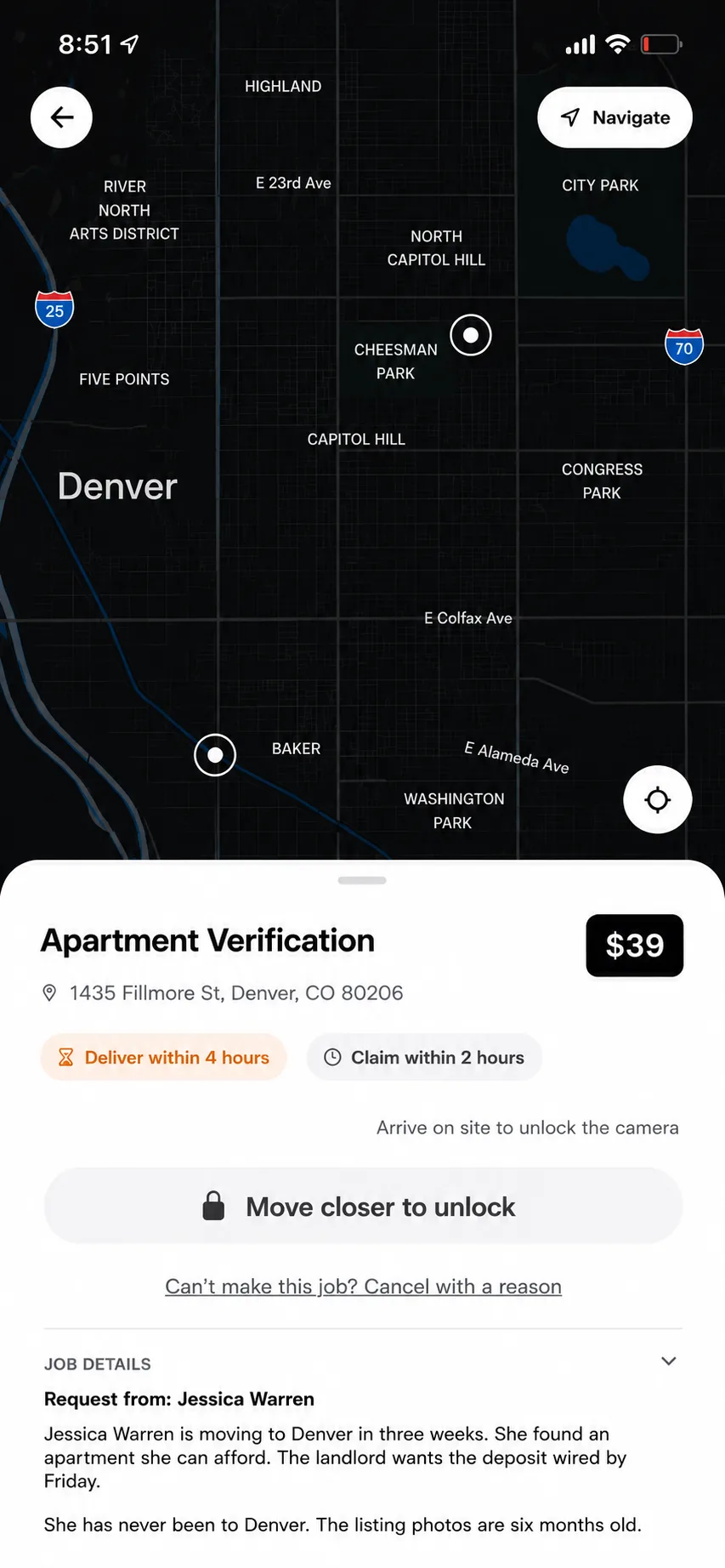
Jessica writes the list, so completeness is not a judgment call. She posts at 8:51 and the hold goes on the card at that moment.
The 70-foot lock
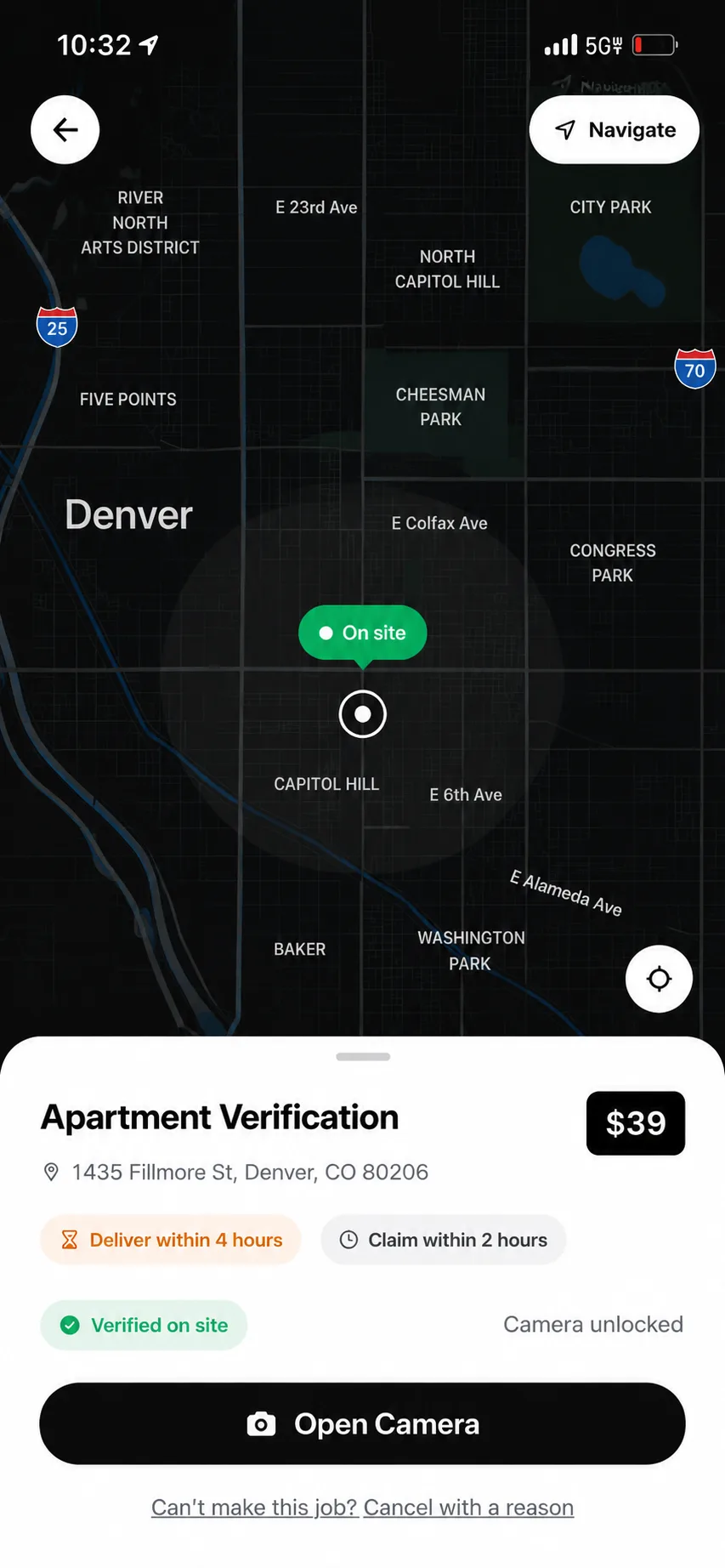
Away from the address the button reads "Move closer to unlock." At 1435 Fillmore the app marks the Snapper verified on site and "Open Camera" goes live. The camera stays locked until your phone reports it's within 70 feet, checked on the server.
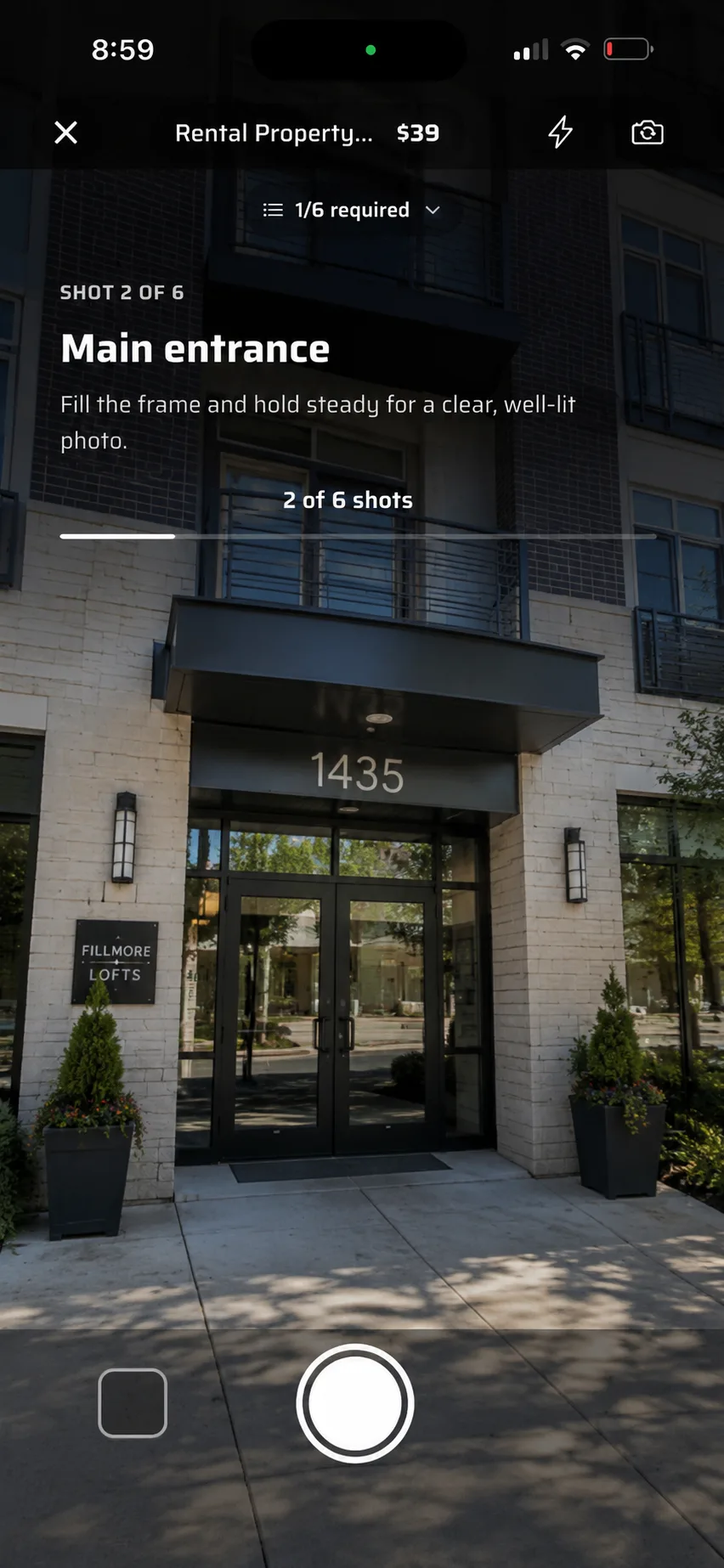
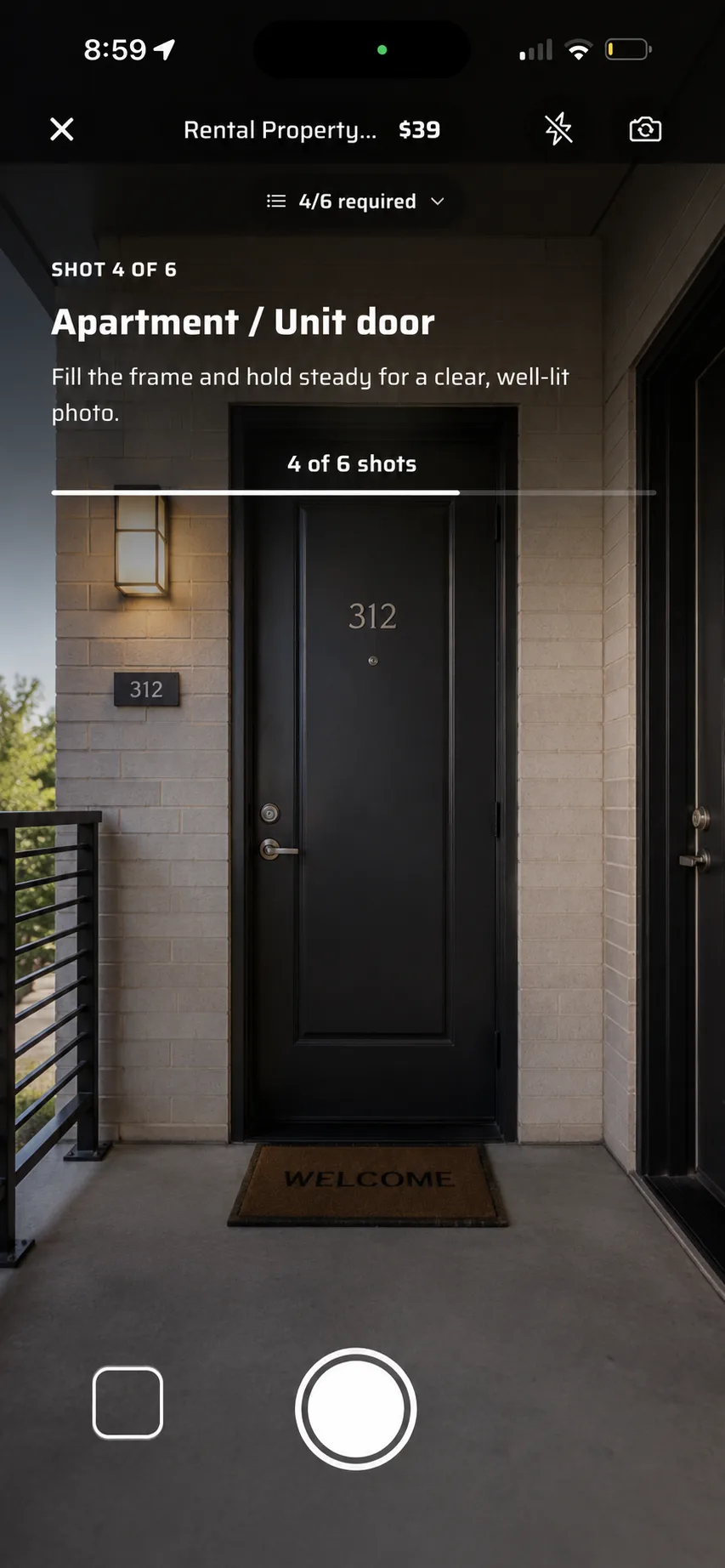
The camera runs the checklist
The app names each shot and counts her through the list. She cannot submit until all six are captured. This is why nobody needs to be vetted.
Four mechanisms of trust
-
01
Held, not charged
Authorized at post. Stripe manual capture. No money has moved.
-
02
Within 70 feet
The camera will not unlock until the phone is at the address. That building, taken now.
-
03
Paid on approval
Not on delivery — on approval. Wrong photos? The Snapper reshoots, the hold stays.
-
04
A required-shot list
The requester defines the shots up front. Completeness is a checklist, not a judgment call.
Cancel at any point and the hold is released. Nobody is ever charged for photos they did not accept.
When it goes wrong
The photos are wrong
The requester asks for changes. The Snapper reshoots. The hold stays in place until it is approved.
Nobody accepts
The job expires. The hold is released. Nobody was charged.
The Snapper cannot get on site
She cancels and the job returns to the pool. Only one job is ever held.
The requester cancels
Any time before approval. The hold is released the same day.
No path ends with someone paying for photos they did not accept.
Why Emily accepts
Emily Delgado, 34, would have been 2.1 miles away when the job posted. She drives for a delivery app between shifts, her phone already in her hand.
She is not a photographer and does not need to be.
- From where she was working2.1 mi
- Posted to approved13 min
- Paid$35.10
Two sides, two reasons
People deciding on a place they cannot reach.
Renters relocating, buyers, out-of-state owners.
Pay $39 for an answer worth thousands. Write the shot list, approve the result.
People already out with a phone in hand.
Couriers, drivers, students, locals.
Earn $35.10 on a 20-minute detour. No gear, no portfolio, no interview.
The business
One revenue line, the shape of job it serves, and where that need shows up.
The $39 job
A 10% service fee. Nothing else. No subscription, no listing fee.
A cancelled or unapproved job earns nothing, because nobody was charged.
-
To the Snapper$35.10Paid out on approval.
-
To SnapDash$3.90A 10% service fee.
What makes a SnapDash job
It is a place
The job is an address. Someone has to physically stand there, and no software replaces that.
A decision is waiting on it
Money, a signature or a claim is held up until somebody sees the place. The photo unblocks it.
The answer has a clock on it
Worth more today than next week. The urgency is in the situation, not manufactured by us.
Too small to send someone
Not worth a flight, an adjuster or a site visit. That gap is the whole market.
The alternatives
-
Errand and task appsScheduled labor by the hour. No photo deliverable, no held payment, no proof of where the phone stood.
-
Local photographersPriced for a shoot, booked for a day. Four frames on two hours' notice is below the minimum.
-
Craigslist, Reddit, local groupsFree and unaccountable. No deadline, no escrow, no recourse.
-
The leasing officeThe one party in the transaction with an incentive for the photos to flatter.
None of them hold the money until the requester says yes.
The same job, everywhere
One mechanism. Every situation where someone needs eyes on an address:
Why now
-
01
Phone cameras crossed "good enough" years ago.
The supply side needs no equipment and no training.
-
02
Held payments and instant payouts are solved infrastructure.
Authorize, capture, split, pay out — an API call, not a company.
-
03
Gig-work supply is liquid in every US metro.
The couriers are already outside, already checking a phone for the next job.
What we have to prove
Targets, not results. Measurement begins the day Stripe goes live.
The company
Where we are today, without decoration.
Abedelmajeed Owda
Founder, SnapDash
This was my problem first. In college there was a place I needed to see, no way to get there, and nobody to ask.
Every piece of the answer already existed — a phone, a map, a payment. Nobody had connected them.
-
Wrote the appSolo. iOS, the Stripe holds, the GPS lock, the approval flow. On TestFlight today.
-
Runs a businessRuns a coffee house in Clifton, New Jersey. Staff, payments, and customers every day.
-
StudiedA.S. Architectural Engineering, Queensborough Community College, plus computer science coursework.
Where we are
-
iOS appBuilt. Running on TestFlight.
-
AccessInvite-only beta.
-
PaymentsStripe connected, test mode. No live captures yet.
-
Users and revenueNone. Pre-launch.
Risk posture
Property access
Public vantage points and common areas. Anything requiring entry is the requester's to arrange.
People in frame
The shot list is about places. Faces are never the deliverable, and a Snapper can decline any job.
Who the Snapper is
Stripe Connect verifies identity before a first payout. One active job at a time, server-side.
Classification
Snappers are independent contractors. We are tracking state-level change.
Roadmap
-
Q4 2026
Public launch
On the App Store with Stripe live. Real holds, real captures, real money — nationwide.
-
2027
Validation at scale
10,000 approved jobs. Time-to-fill, approval rate and reshoots measured on real transactions, not projections.
-
2027–28
Marketplace density
Build Snapper supply where demand concentrates. Density is what makes a 70-foot radius fill in twenty minutes.
-
2028
Intelligent expansion
New regions on proven demand, supply density and unit economics. Live signals decide, not a plan written today.
Every address in America is twenty minutes from someone with a phone.
Jessica would not have flown to Denver. Emily would have made $35.10 on a shift she was already driving.
Abedelmajeed Owda · support@getsnapdash.com